MindsEye is a bit of a mess. The first proper effort of Build a Rocket Boy, a studio helmed by former GTA developer Leslie Benzies, the game fell flat on its face mostly because it was just wasn't great. The studio hasn't given up on it though, in part because it was apparently all because of saboteurs.
I won't sit here and naysay all of that, but I do have to wonder out loud how corporate espionage produces a game with pretty mid combat and an unappealing story—I mean, MindsEye's debut trailer was set to Mad World. Its first impression gave me 'this game wandered out of the early Xbox 360 era with no self awareness'.
Then, in February of this year, Benzies stated that some of the individuals the studio had allegedly caught doing something would star in an upcoming mission: "We will use these people, these names and these facts for our own fun. We’re gonna put some of these names into our upcoming spy mission." Normal!
Given that this was just initially an internal meeting, you'd be forgiven for thinking it to be a mere moment of corporate fugue: But no, this really is what Build a Rocket Boy is doing. It is going to use a DLC to dunk on former employees it alleges sabotaged its ostensibly mid videogame.
In a recent Gamesbeat interview, Benzies states that the new mission, dubbed Blacklist, will be used "to share some of the evidence of the sabotage with the community".
Earlier in the talk, Benzies seems to think it's all well-in-hand, that the evidence is compelling and that the truth will all come out. What truth? Who's to say: "We’ve got very strong evidence of this and conducted quite thorough investigations over the months since launch. We’ve identified parties involved, and it’s now with the authorities both [in the] U.K. and U.S. to deal with.
"I can confirm that they’re assisting us with this investigation, but it’s also in their hands now. We’ll leave them to do what they do, make their arrests or any announcements in due course. I think we’re not saying anything further at this stage on that. We’ll just let the natural course of justice take its path."
Look, maybe there actually was large-scale saboteur work going on at MindsEye, based on the sheer confidence Benzies has that people are going to get potentially arrested over it. That confidence has translated to naming and shaming said people in a mission called Blacklist, which I have to assume is trying (and failing) to be subtle about the mission itself blacklisting those people from the industry.
But also, doesn't that seem a little petty for something you're taking serious legal action on? If there was espionage at work, wouldn't that show up as like… something more than just an inoffensively poor videogame? Isn't making an update where you name and shame developers whose guilt is yet to be proven in a court of law jumping the gun just a little?
We've finally uncovered another Overwatch hero, and while we don't know her name yet, Hero 51 is looking cool as all hell in the bottom right corner of the new heroes image alongside Mizuki, Domina, Emre, Anran, and the infamous Jetpack Cat.
Hero 51 looks to be a modded human, kitted out in tactical gear with what looks like a high-velocity rifle. She's also got a braided ponytail that reaches the floor and is accompanied by an Omnic bird. Like I said, sick as all hell.
Respectfully… y’all aren’t ready for this one 😮💨🔥Join us Apr 8 at 9am PT for the premiere of our latest Hero Trailer as we kick off the next chapter in the Reign of Talon 💪 pic.twitter.com/1Etxn68taxMarch 31, 2026
But not everyone is happy with Hero 51's looks. Some say that she seems a bit too derivative to keep up with Overwatch's original style. "I love Overwatch’s very original and distinct character designs," one player says. "I squinted my eyes and this literally looks like a preexisting, iconic design of another character. From another game IP at that." Others are simply calling her "Legally distinct Cammy".
I'll admit, I see the similarities. I think the beret and tactical gear don't exactly help her case. You can also compare her to Widowmaker's Cammy skin from the Street Fighter collab, which again looks similar. But no one brand owns army gear and berets, so while Hero 51 may have a lookalike from another game, I don't think it takes away from the fact that the character design looks sick.
(Image credit: Blizzard )
We'll find out more about Hero 51, like her abilities and name, next week on April 8 when her hero trailer premieres, which will also coincide with the next chapter of The Reign of Talon kicking off. I wonder where the story will take us next. She could well be a new Talon recruit brought in to pad out the ranks after Reaper, Widow, and Sombra left the organisation due to Doomfist being deposed by Vendetta. But it's looking more likely that Hero 51 will be part of Helix, a peace-keeping force which is the replacement to Overwatch, due to the logo being on her jacket.
This wouldn't necessarily make her one of the good guys, though. Helix has a complicated reputation. They may officially be a peacekeeping force, but they're also known for using excessive force and having a disregard for collateral damage. Jack Morrison (Solider 76), has called them nothing more than mercenaries.
I'm certainly excited to find out more, but I also have to be honest and admit that the hero I'm most excited to see next is the mysterious figure located just behind Hero 51. Could it be an Omnic cowboy or even a noir spy? I hope so, because either would make for a legendary Overwatch character.
Crimson Desert's moment is continuing. Pearl Abyss's open-world romp is obtuse and a bit divisive, but that doesn't seem to have been an obstacle. Today, the studio announced that it had hit another sales milestone.
In just shy of two weeks, Crimson Desert has sold 4 million copies—an impressive result for the studio's first singleplayer game.
"Crimson Desert has sold through 4 million copies worldwide," the official account shared on X. "Thank you to all the Greymanes who have been a part of this journey with us and for all of your incredible love and support."
#CrimsonDesert has sold through 4 million copies worldwide. Thank you to all the Greymanes who have been a part of this journey with us and for all of your incredible love and support. pic.twitter.com/ZJdavC9FORApril 1, 2026
I'm not entirely surprised.
Like I said last week when I sang Crimson Desert's praises, it's the exact kind of game that PC players in particular go wild for. It's a big ol' weirdo. But it's also a looker, and a massive open-world affair, launching during a pretty quiet period. The stars really aligned for this one.
Crimson Desert's launch was not without its problems, though. Bizarre design choices, jank and performance issues netted it a Mixed user review rating on Steam initially, though that quickly climbed up to Very Positive, where it has remained.
It took a moment because it's the sort of game that requires players to put the work in, but Peal Abyss has also released several updates and hotfixes over the last couple of weeks, though it's not all been plain sailing.
Over on PCG's hardware team, Andy Edser's been having some issues, despite the patches. Specifically he, and plenty of others, have been dealing with poor ray construction performance and visual glitches.
A lot of folk continue to be put off by the… unusual controls, as well, though Pearl Abyss says it will be making some changes. It's certainly seemed on top of things so far, so if you've been holding out for some more fixes before you jump into Pywel, hopefully you won't have long to wait.
"Recent sharp price corrections across U.S. and China retail memory channels have pushed DDR5 modules to the center of a broader sell-off, further fueled by market debate surrounding Google’s TurboQuant. The development has raised questions over whether this signals an inflection point for weakening demand," is the analyst outfit's opening salvo in a news post.
Somewhat surprisingly, Trendforce's main source here appears to be some informal reporting by WCCFTech covering the German and US markets, plus a further Chinese source for that market.
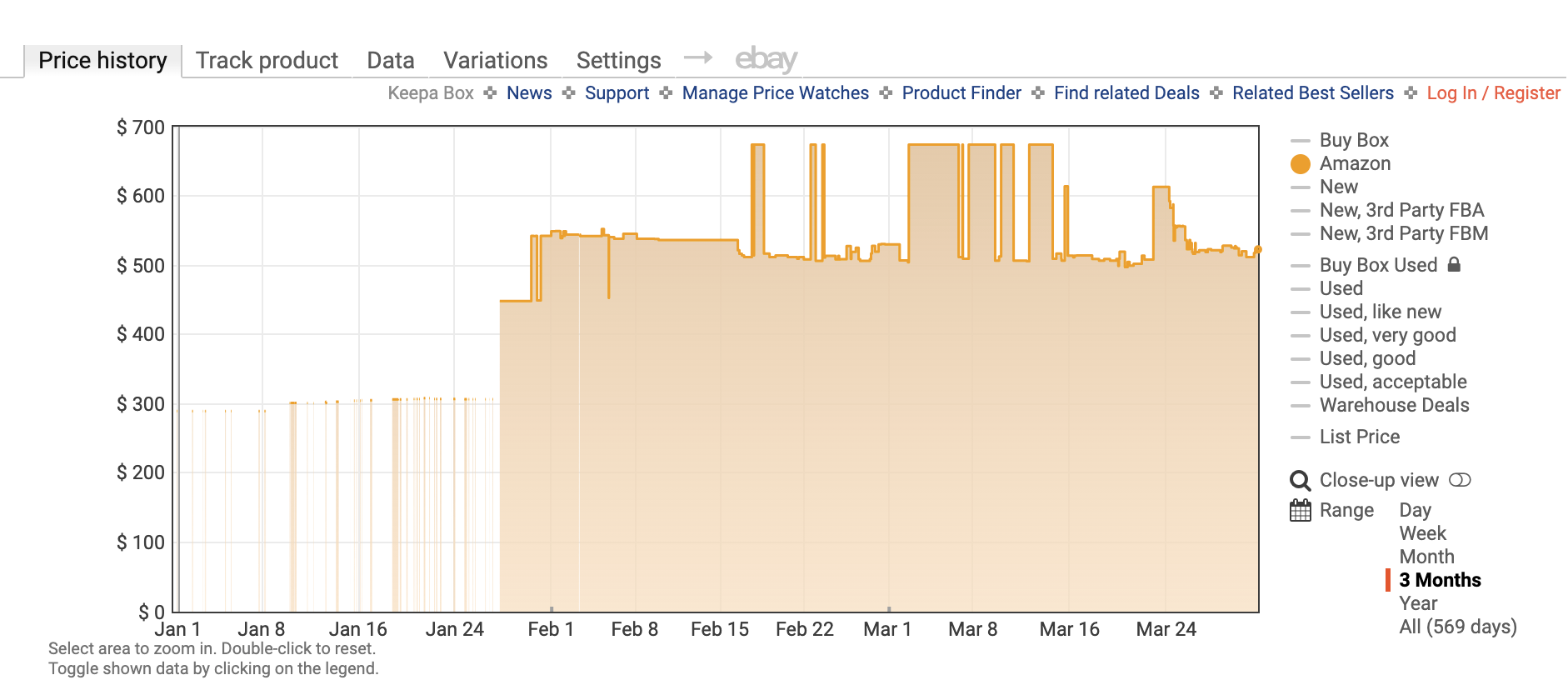
When I trawled the usual online retailers yesterday, I found that some DDR5 kits were indeed lower than their absolute peak during this memory crisis. However, it's hard to argue that the historical price graphs on Amazon show a downward price trend.
Instead, as I said of a particular DDR5 kit, "if you observe the price trend of the 32 GB version of that Kingston kit, you'll see that the price has been essentially oscillating between $657 and around $515 since February, with it mostly being listed at the lower price."
That's true of many memory kits. Indeed, Trendforce caveats all this with the proviso that some industry sources say "contract prices from major memory suppliers have remained completely stable."
Trendforce then concludes, "on balance, the current DDR5 price correction appears to be a consumer-driven, short-term adjustment rather than a definitive signal of structural demand deterioration. Contract prices have so far held firm, and server-side HBM and DRAM demand has remained largely intact, with major suppliers reportedly locked into multi-year agreements with key clients.
"For now, the industry’s long-term fundamentals appear largely unchanged — but whether the recent turbulence proves to be a healthy cooldown or an early warning sign might only become clear in the months ahead."
A notable dip in DDR5 memory kit pricing isn't immediately obvious. (Image credit: Amazon)
But, ultimately, all of this surely hinges on the fate of the AI industry. If it implodes, memory prices will surely collapse. If the hype proves fully founded, on the other hand, it's hard to see memory chips returning to pre-AI prices for years. Watch this space, in other words.
One of the most popular JavaScript libraries, Axios, was recently the victim of an attack that had fake, malicious versions available to roll out to developers. These malicious versions install a remote access trojan (RAT), which is, as the name implies, a kind of malware that allows an attacker to access compromised devices from a remote location.
Google has identified the attackers responsible as likely being UNC1069, "a financially motivated North Korea-nexus threat actor" that goes by CryptoCore.
They compromised the Axios maintainer's npm account, npm being a trusted online registry of JavaScript code for users to share and use. Two poisoned packages were added to the Axios npm, and these added a new dependency that installs a RAT.
Malicious code never got into the official Axios software itself, which remains safe, but instead two separate malicious versions were published from an account that usually publishes legitimate Axios versions. Given the way npm works, these compromised, fake versions were able to be pushed to some developers.
The attack was staged almost a day in advance, the two poisoning attacks were timed pretty precisely, and evidence was erased post-exploit, pointing towards a calculated rather than opportunistic attack.
As cybersecurity company StepSecurity explains: "This was not opportunistic. It was precision. The malicious dependency was staged 18 hours in advance. Three payloads were pre-built for three operating systems. Both release branches were poisoned within 39 minutes of each other.
Every artifact was designed to self-destruct. Within two seconds of npm install, the malware was already calling home to the attacker's server before npm had even finished resolving dependencies. This is among the most operationally sophisticated supply chain attacks ever documented against a top-10 npm package."
However, it's important to note that developers using Axios wouldn't have been automatically infected. The malicious versions would have been automatically installed by many projects whenever they next run an npm install command. How often this command is run depends entirely on the company—maybe every week or two, or with a new package install.
(Image credit: Chris Ratcliffe/Bloomberg via Getty Images)
Given that the malicious versions were removed within a few hours, it's likely that most developers using Axios are safe. However, BitDefender says its "telemetry confirms RAT execution attempts on customer systems, blocked by GravityZone and says "the blast radius is not theoretical."
The company recommends identifying exposure, assessing for prior compromise, and monitoring outgoing. Malwarebytes says: "If you are a developer deploying Axios, treat any machine that installed the bad versions as potentially fully compromised and rotate secrets. The attacker may have obtained repo access, signing keys, API keys, or other secrets that can be used to backdoor future releases or attack your backend and users."
Someone from a cybersecurity site and educational malware repo, VX-Underground, recently explained the severity of this on X as follows: "The impact from Axios being compromised is devastating, the fallout from this will be a massive headache. This is unironically a malware nuclear missile and will likely be studied in the future."
As the ongoing memory crisis continues to make DRAM unaffordable for the majority of us, I'd imagine many are choosing to hold onto what they've got. But can you run a PC with no system memory at all? That's the question that YouTube channel PortalRunner has been investigating, and the answer is...
No, not really. After realising that a new editing server would require considerable amounts of both SSD storage and DDR5 RAM, PortalRunner began by attempting to lower the initial DRAM loadout of a machine to its minimum point.
The first experiment involved tweaking Linux boot parameters to limit system memory to a measly 256 MB (hey, remember when that was a good amount?), but the system failed to initialise (via Hackaday). After some tomfoolery with the boot settings, a 446 MB DRAM limit, and just 4 GB of swap space on a SATA SSD allowed for a successful startup.
Unfortunately, the system ended up being too slow to pass PortalRunner's three stress tests—a browser benchmark, a memory access test, and a Portal 2 bench to test out casual gaming.
This configuration caused the browser benchmark to crawl to a near halt, the memory access speed test to output a miserable 68 MiB/s result (compared to 11,069 MiB/s using a 4 GB RAM control system), and the Portal 2 benchmark to fail entirely, as Steam refused to load correctly. Quelle surprise.
A later experiment involved using graphics card VRAM as a system memory replacement, via a modded swapfile on a GTX 1660 Super. This caused multiple crashing issues, as Linux began killing processes to fit within its constraints, and led to two failed benchmarks and an unbelievably slow browser test.
(Image credit: PortalRunner)
Eventually, PortalRunner settled for modifying a BIOS chip to prevent system DRAM usage and leaning on the CPU cache of an old Intel chip as a memory substitute. This satisfied the initial goal of running a machine with technically no traditional RAM at all, but also limited the system's capabilities considerably.
How considerably? Well, it can technically output a custom-coded Snake clone over a serial port. Briefly. Until the data-providing BIOS chip is removed and the cache is left to its own devices, which causes it to freeze. That's about the bare minimum qualification of a working computer I can think of, but hey, small wins, etc., etc.
(Image credit: PortalRunner)
Ultimately, all of PortalRunner's efforts amount to an excellent explanation of why DRAM is so vital to a modern system, and confirm that you absolutely need some to run a functioning machine by most people's standards. So no, I'm afraid it's not the solution to the memory crisis you might have hoped for. It's good fun, though, and you may well learn something about how your PC works along the way.
Assessor Matrix is a new material added in Arc Raiders' Flashpoint update, and they're painfully hard to get. If you thought finding some Vaporizer Regulators was bad, buckle up, buddy. But you'll still have to get them, since the High-Gain Antenna project demands you find 24 of the suckers. That's a lot, by the way.
I'll cover how to get Assessor Matrixes below, as well as a few tips that'll help you actually grab them, as it's far easier said than done. Most importantly of all, bring strong Arc-slaying guns like the Hullcracker or Aphelion and plenty of healing.
How to get Assessor Matrix in Arc Raiders
(Image credit: Embark)
You can only get Assessor Matrixes by breaching and looting the Assessor drop pods during the Close Scrutiny map condition. For now, at least, this event will always be active on one of the available maps at any given time.
Assessors are three-legged platforms that fall from the sky, and when they land, they'll emit red laser beams. Track one down, and you'll see that it has three breachable containers. Each one has a chance to spawn an Assessor Matrix, so you could get lucky and find three of them. Assessors also contain a variety of Arc materials and potentially even the new Dolabra blueprint if you're lucky.
However, Assessors are heavily guarded by Arcs and often contested by other players. While you could work together to take down the Arc guarding the cache, you also risk other players getting to the loot before you. What you can do to improve your chances is to:
Use a Photoelectric Cloak to sneak in and out while breaching so you can grab the loot while other players are busy
Throw smoke grenades while you're breaching a container to avoid Arc tracking you, letting you grab the loot and run
Bring friends and strong gear like Hullcrackers and Wolfpacks to kill Vaporizers and other Arcs that spawn, and divvy up the loot between you
Nevertheless, you'll have to brave the Close Scrutiny event in search of Assessors one way or another, and it won't be particularly quick to collect everything you need.
Modern software and technologies are often so complex that it's inevitable there will be some glitches or odd behaviours to begin with. In the case of Nvidia's new Dynamic Multi Frame Generation, which all RTX 50-series owners can now use, there is definitely one problem that needs to be addressed.
To get a complete handle on screen tear, many PC gamers prefer to set a frame rate cap a little below the maximum refresh rate. That way the performance always remains with the window that the monitor's variable refresh rate operates, and you get silky smooth frames on the screen.
(Image credit: Nvidia)
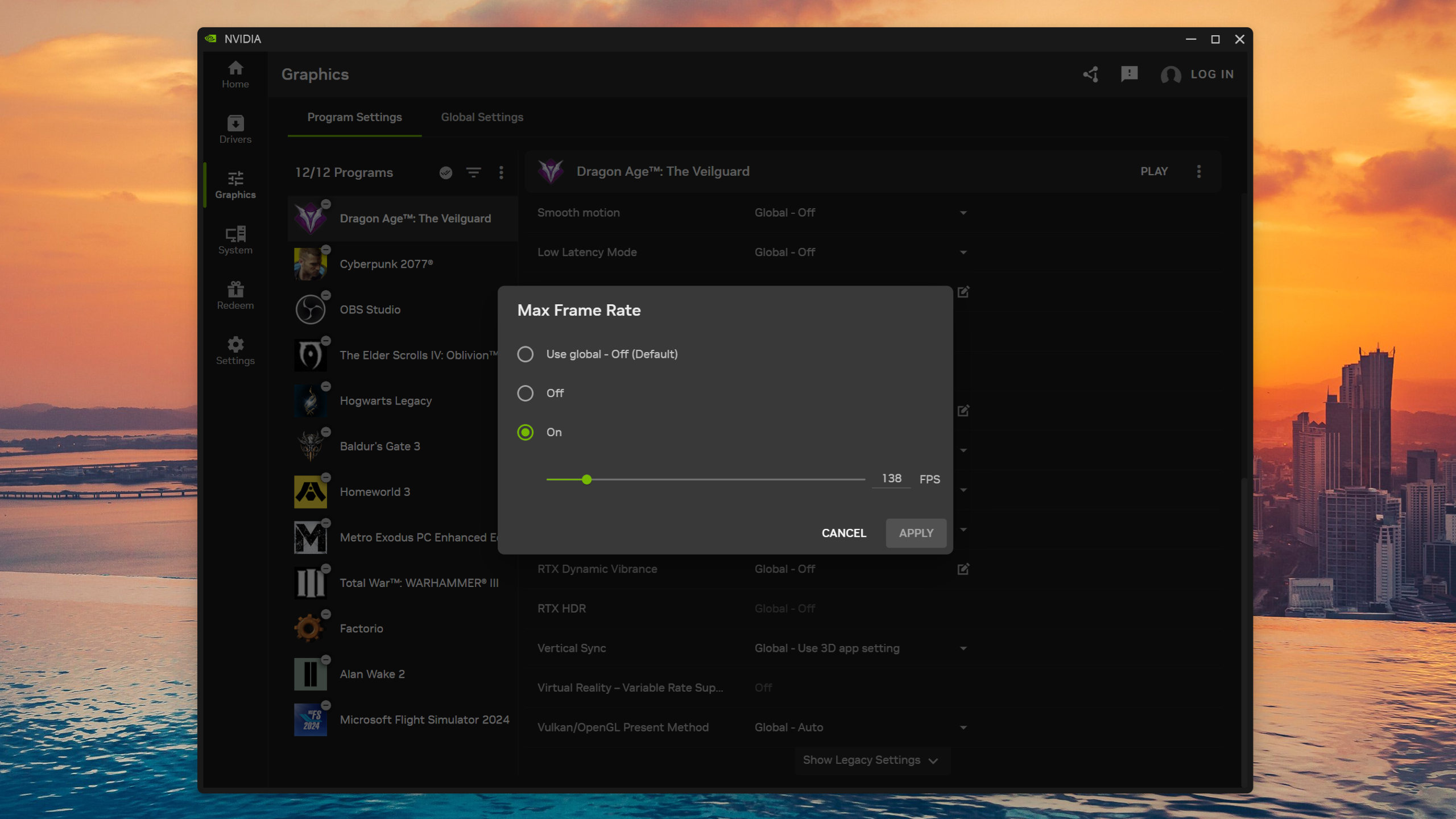
You can do this in some games directly, but it's best to do it via Nvidia's drivers, either in the Nvidia Control Panel or in the global settings of the Nvidia App. Using Dragon Age: The Veilguard, running at 4K with DLSS Quality and the High graphics preset, on a Ryzen 9 9950X3D and RTX 5070 combo, I found that Dynamic MFG fully behaved itself when used without any limit to the frame rate.
That said, it also lets the performance completely overshoot the refresh rate. However, when I set a cap of 138 fps in Nvidia App, Dynamic MFG decided that it didn't want to play ball and just ran in 6x mode all the time.
While the performance you get is fine, the reported PCL figure certainly isn't. When using DMFG without any limit to the frame rate, it comfortably sits around the 30 millisecond mark, which is nice and smooth to game with. With the 138 fps cap, though, the PCL jumps to around 50-60 milliseconds, which certainly isn't smooth.
I've tried a variety of different settings in the game, but in all cases, when using a frame rate cap in Nvidia App, Dynamic MFG just locks to a fixed mode. In one example, it always stayed in 3x, which was okay to game with as the PCL remained under 40 milliseconds.
This could be a bug or just a limitation of how Nvidia's Dynamic MFG all works. Hopefully, it's the former, because that means there's a chance it could be fixed at some point in the future. If it turns out to be a limitation of the system itself, then you'll want to stick to the standard Multi Frame Generation if you always use a frame rate cap.
I've also seen some reports that DMFG doesn't like certain performance overlays, such as MSI Afterburner/RTSS, but having tested that in a few games, it doesn't appear to be an issue. In Cyberpunk 2077, Dragon Age: The Veilguard, Oblivion Remastered, and Hogwarts Legacy, RTSS displays correctly, and Dynamic MFG works as intended.
That doesn't mean there aren't games where RTSS and DMFG don't play happily together, and if you're currently experiencing such issues, flag 'em up below in the comments.
Fragmented Logs is one of the most annoying quests in Arc Raiders, mainly because you're sent through some of Stella Montis' biggest deathtraps. It's not helped by the fact that the map is a maze. On the bright side, you don't need to complete it in a single run, so don't worry too much if you die midway through.
Below, I'll give you a step-by-step guide to beat Fragmented Logs, including where to find the Robotic Sandbox terminals, the conduit backrooms, and the main frame data.
How to complete Fragmented Logs in Arc Raiders
First things first, you will need one Electrical Component, which I recommend bringing with you to save time. You can craft them at a Refiner using plastic and rubber, recycle various tech and equipment (like Wasp and Hornet Drivers, Snitch Scanners, Looting MK.2, and so on), or search Electrical areas to find them.
Once you've got an Electrical Component, you're ready to complete the three Fragmented Logs quest steps on Stella Montis. These can be done in any order, but I'd recommend starting with the out-of-service terminal in Robotic Sandbox since this is the objective that requires the Electrical Component.
Repair the terminal in the Robotic Sandbox control rooms
EmbarkEmbark
To repair the out-of-service terminal, you need to head to either side of the Control Room between Robotic Sandbox A and B. There are various stairways leading to this area if you follow the signs, but if you're down in Robotic Sandbox A, you can ride the construction lift up the walkway.
Head inside the Control Room, and you'll find a computer that you interact with to repair using your Electrical Component. I used the terminal on the southeast side overlooking Robotic Sandbox B, next to the heptagon-shaped desk.
Enable power in a conduit backroom near Robotic Sandbox
EmbarkEmbarkEmbark
Next, you need to head to one of the small offshoot rooms in the hallways downstairs by Robotic Sandbox A or B. I used the one near Robotic Sandbox B, labelled Control Room B2 above the door, since it's closer—it's on the ramp leading south from Sandbox B, near the Raider Hatch.
Enter the conduit backroom and you'll find a main power switch between what look like large server terminals. Pull the switch to complete this objective.
Boot the mainframe data terminal in Cultural Archives
EmbarkEmbark
The last objective is in the Cultural Archives on the far east of the map, which you can access via the Business Center or Atrium. You're looking for the small room that sticks out further east toward the centre of the Cultural Archives. Inside, you'll find a computer desk next to server boxes that you can interact with. If you've been to the Cultural Archives before, you'll know this place is infested with Shredders, so be careful.
You don't need to extract with anything, so find your nearest safe exit and get out of there. In return for your hard work galavanting across Stella Montis, Shani will give you three Showstoppers and three Trailblazers. It's not much, but they're sure to come in handy if you're taking on the new Close Scrutiny map condition.
Disney Dreamlight Valley is rolling out its Whispers of the Wind update on April 8, adding Pocahontas and a bunch of new friendship quests to work your way through. If you want to make your way through these quests as quickly as possible and invite Pocahontas to your valley, then a little preparation goes a long way. Without knowing what quests we'll be sent on, it's hard to know the most efficient way to prepare, but using the information we've received on the update, there are a few things I'll be doing at the very least.
This time around though, unlike the majority of Disney Dreamlight Valley updates, you don't need to work on saving up your Dreamlight to unlock a new realm in the Dream Castle. Instead, you'll visit a new mysterious island off the coast, which is where the journey to unlock Pocahontas begins.
How to prepare for the Whispers of the Wind update in Disney Dreamlight Valley
As always, there's nothing you strictly need to do to prepare for the update. Once it's released, every player will be able to access it and make their way through Pocahontas' friendship quests. Since it's her debut in Disney Dreamlight Valley, there are no friendships you need to work on with other villagers in advance either. But there are a few things you can do to prepare in advance.
Gather gemstones
Even though we don't know what friendship quests we will be sent on with Pocahontas, we do know that we'll be preparing a "celestial celebration" as shared in the trailer for the update. If there's one thing that screams celestial to me, it's glittering gemstones. So, to save yourself the stress of having to gather gemstones once you reach the quest, gather some which are harder to find, like tourmaline or diamonds.
Befriend raccoons
(Image credit: Gameloft)
If there's one thing that screams Pocahontas to me, it's raccoons. So, I'm going to spend some time befriending the raccoons in the Forest of Valor. If you're yet to befriend these masked bandits, then forage for some blueberries and approach them slowly. They're quite quick, nervous critters and you need to feed them for at least three days to unlock them as a companion too. With that said, we do know that you'll unlock Meeko, Pocahontas' raccoon companion, as part of her quests.
Gather hardwood
I've always found that hardwood is one of the most frustrating materials to gather in Disney Dreamlight Valley, even though it spawns in the Sunlit Plateau, Forest of Valor, Frosted Heights, and Glade of Trust. That's largely because it always spawns in fixed numbers and takes a while to respawn once you've gathered it.
Since it's always used for crafting bigger structures, it's one of those essential materials you just have to gather too. We don't know how we'll get to Pocahontas' mysterious new island, but if we need to craft a raft or anything like that, we'll no doubt need hardwood.
Primate Labs says that Intel BOT "only supports a handful of applications, meaning BOT-optimized benchmark results paint an unrealistic picture of how a CPU performs in practice. This makes Intel processors appear faster relative to AMD and other vendors than they would be in typical, real-world usage."
Primate Labs actually carried out their testing on a Panther Lake laptop rather than one of the new Arrow Lake Plus chips. Turns out Intel's Panther Lake CPUs also support BOT, something Intel didn't initially flag.
Anywho, Primate Labs says, "Intel’s public documentation on BOT is limited, so we decided to dig in ourselves to understand how it works and what optimizations it’s applying to Geekbench."
Primate Labs claims it discovered that BOT is going well beyond Intel's characterisation of how the software operates.
"Based on the instruction counts, it’s clear BOT has performed significant changes to the HDR workload’s code. The number of total instructions is reduced by 14%. Most of that reduction comes from BOT vectorizing parts of the workload’s code, converting instructions that operate on one value into instructions that operate on eight values.
"This is a significantly more sophisticated transformation than simple code-reordering. Intel’s public documentation only discloses the simpler code-reordering techniques, not the vectorization transformations observed here," Primate Labs says.
If Primate Labs is correct, that's certainly something of a concern. To quote myself from last week, "my understanding is that what Intel's BOT is doing essentially amounts to re-ordering instructions so that they fully utilise the Arrow Lake Plus pipeline. All the actual calculations are the same. In other words, enabling BOT doesn't mean skipping any work."
Intel likens BOT to a game of Tetris where instructions are more optimally ordered. (Image credit: Intel)
I said that based on Intel's description of how BOT works, but if Primate Labs is correct, there's quite a bit more going on. Primate Labs also found that BOT adds a time penalty to application start up. "When running Geekbench 6.3 with BOT enabled, the first run has a 40-second startup delay before the program starts. Subsequent runs are faster, with a 2-second startup delay. The startup delay disappears when BOT is disabled," the blog post explains.
Ultimately, this all comes down to how many applications end up supporting BOT. My understanding is that application support will require Intel's Labs specifically doing optimisation work and adding the results of that to the tool. Quite how many apps Intel will choose to optimise is unclear, but the fact that BOT is never going to just work with any given app is a clear negative. Primate Labs probably has a point here, therefore.
Minecraft revealed its second drop for 2026 during Minecraft Live: Chaos Cubed. And, while the main appeal of this announcement is the brand new Sulfur Cave biome it'll receive, I'm far more excited for the brand new mob, the Sulfur Cube. This cave-dwelling beast has stolen the hearts of many players already, including my own, and for good reason.
The Sulfur Cube is the only mob of its kind in Minecraft, so it's got a lot of peculiar quirks and qualities that players are excited to make the most of. The only downside is that we currently don't know when it'll become available, so it could be a hot minute before the Sulfur Cube is added to the game. Here's all the info we do have, though, so you know exactly what to gear up for.
When is the Sulfur Cube being added to Minecraft?
The Sulfur Cube will be added to Minecraft as part of the Chaos Cubed update, which doesn't have a release date yet. Given Minecraft produces a new drop each quarter though, we do know it'll launch around Summer. Should it correspond with the drop schedule of last year, we are anticipating this to roll out around mid-June too.
What does a Sulfur Cube do in Minecraft?
(Image credit: Mojang)
Aside from looking adorable, the Sulfur Cube has one unique skill that separates it from the rest of Minecraft's mob roster: the ability to consume blocks and take on their attributes. This doesn't mean the cube simply takes on the appearance of a block either, oh no, it takes on the characteristics of whatever it consumes.
For example, if you feed a Sulfur Cube ice, it will start to slide rather than defaulting to hopping around. Whereas if you feed the cube wood, it acts sort of like a "ball" (despite being a cube still) which you and your friends can use for different minigames like setting up a cube-y match of croquet, or golf. These aren't the only blocks the cube can consume either, even though they are the only ones we've seen in action.
According to the official blog post recapping the announcement, the cube can absorb "loads of different blocks" and will have "infinite potential for experimentation." Meaning, the full abilities of the Sulfur Cube are down to us to explore, and since we're a ways out from seeing the Chaos Cubed update, it'll be a while before we can even get stuck into testing. I don't doubt everyone will be quick to see which hilarious attributes they can give their Cube though, and I look forward to seeing how they are implemented into minigames.
Because of how little we know about the Chaos Cubed update in general, we don't know if the Sulfur Cube drops anything when killed, or if it can be tamed or bred yet either. That's all part of the fun of waiting.
The Nvidia App beta has been updated to include DLSS 4.5 Dynamic Multi Frame Generation support for RTX 50-series owners. The much-anticipated tech allows for dynamic adjustment of AI generated frames based on a target frame rate, with the goal being consistently smooth, high fps gameplay.
The tech allows for up to 6x frame generation, which is a considerable boost over the 4x maximum of previous efforts. Our Nick has been testing the tech recently and has come away somewhat impressed, although there are caveats to maxing out the number of generated frames, particularly on lower spec cards.
DMFG can be either activated as a global option, or per individual game via the Graphics tab in the Nvidia App. The app can be configured to sync up with your monitor's refresh rate, or configured to a custom max frame rate for those who like to tweak the settings.
A new DLSS Frame Generation model (for RTX 40-series and 50-series cards) is also included with the update, which aims to take into account UI screen elements and provide better stability of frame-generated images when interacting with onscreen overlays and text.
(Image credit: Nvidia)
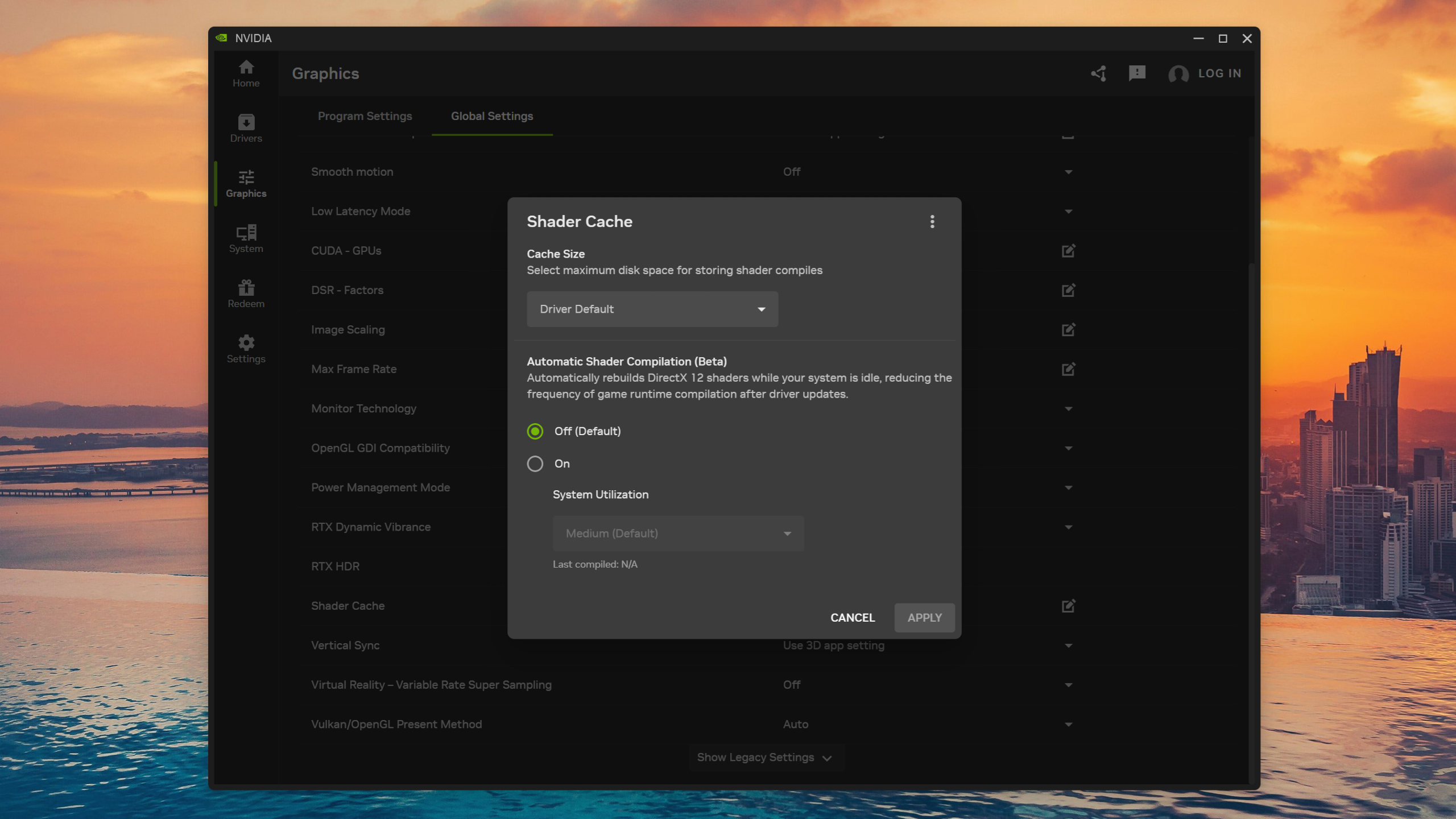
The update also adds a beta preview of a feature called Auto Shader Compilation, which attempts to rebuild your DirectX 12 game shader cache after a driver update during system idle time.
With more and more games avoiding stuttering issues with an initial shader compilation pass, the feature aims to cut down on a complete rebuild of the shader cache for every game after every driver update. As Nvidia has been firing out the hotfixes for its drivers at a rapid rate over the past few months, the beta preview of this particular feature seems timely.
Users will need to opt into the beta version of the app within the Settings>About page to test it out, and will need GeForce Game Ready Driver 595.97 to take advantage of all the new goodies.
After the first season of Fallout launched on Prime Video, Amazon boasted it had been watched by 65 million people, making it their biggest hit since The Rings of Power. Unlike The Rings of Power, people actually seem to have liked Fallout's second season, which The Hollywood Reporter reports has now been seen by 83 million people.
At least, in part. Streaming figures are apparently based on how many viewers pressed play, not on how many stuck around for the finale, so it's worth taking them with a grain of salt. Still, 83 million is a lot of people who are at least curious to watch the further adventures of Walton Ghoulgins, whether they checked out five minutes in or not.
The second season's release had a bit of a halo effect on the first season, pushing it up to 100 million views. (Or partial views, again.) "Fallout continues to resonate in a powerful way with our global Prime Video audience," Peter Friedlander, head of global television at Amazon MGM Studios, was quoted as saying by The Hollywood Reporter.
"The show's performance reaffirms this," Friedlander went on, "with season two now joining season one as two of our top four biggest seasons we've ever launched. We're thrilled to see the franchise continue to grow as we head into season three."
I've been pretty good this year and avoided flooding my Steam library with more games I don't have time to play, but Steam's latest themed sale got me. From now until April 6, Steam is running House and Home Fest. It's basically seven days of homey, cozy games that feel specifically targeted at me.
I'm basically a videogame realtor, and all about anything that lets me build, organize, or clean some semblance of a house. I've scrubbed the dirt off of countless rooftops and walls in PowerWash Simulator, and who knows how many permutations I've created of my idealized working space in My Dream Setup. God forbid I apply that energy to cleaning my own house.
If that sounds like you, then I've got a few cozy game recommendations worth checking out in Steam's House and Home Fest.
This one is a recent favorite, but I was smitten with the cute critters of Creature Kitchen when I wrote about the demo a month ago. I've completed the full game since, and even went back for some achievement clean-up since I couldn't get enough of the creepy-cozy cooking sim.
It's a short game—it took me about six hours to finish everything, achievements included—but perfectly paced with just-difficult-enough puzzles and tons of weird little guys to befriend. I loved looking for clues to make snacks for the mice in my walls or the weird apparition in the pantry. They're pickier eaters than I would have expected, but once you figure it out, Creature Kitchen is a satisfying little puzzler.
Look, I recently tried to replay the original PowerWash Simulator since I didn't finish all of its DLC, and I just can't go back to it after playing the sequel. Months later, I still stand by everything I outlined in my PowerWash Simulator 2 review, and feel the upgrades made in its sequel are just too good to handwave and go back to ol' faithful.
New attachments like the Swirlforce Ace, a heavy-duty circular cleaner, and upgrades to the soap system are gamechangers. Couple that with improved co-op, and it's way more fun for everyone involved. The Adventure Time DLC is on its way soon, so it's the perfect time to scoop up the sequel if you haven't already.
💲 Price: $24.99/$21.24 |£19.99/£16.99 ✅ Has a demo
I just started playing Hozy, but I've loved my time with the fixer-upper sim so far. While there's no shortage of things to do, I love that it doesn't let me overwhelm myself by trying to tackle a million little projects at once. Instead, Hozy breaks down remodeling an entire neighborhood into several smaller cleanup jobs where you restore old buildings one room at a time.
You'll do everything, too. Pick up the trash, scrub the floors, squeegee the windows, paint the walls—Hozy gets pretty granular with the work that goes into making buildings as good as new. But the best part comes at the end, when the game dumps boxes full of furniture and clutter into your lap and lets you go wild.
Speaking of unpacking, you can do that in… Unpacking. The 2D home decor sim is all about the best parts of Hozy, but with a dash of puzzle-solving as you try to make everything fit into your new room. Every room starts with a neat pile of seemingly endless boxes, and you've got to find a home for every action figure and roll of toilet paper in there.
Unpacking caters to the maximalist in me. Screw overly sanitized spaces and homes with hotel vibes. I want crap in every corner and lived-in spaces with real personality. Unpacking lets me do that, but on a handy grid to make sure I get the symmetry right. I should try that when I'm hanging frames in real life.
My Little Life is another one I started recently, but so far I'm having a good time tending to the tiny, needy people making demands at the bottom of my screen. Considering it's an idler, they're pretty patient little dudes, but they rely on you for more than just cute decor and shelter.
While those things are important, the tiny humans also rely on their desktop gods for food, comfort, and even new career paths. It's kind of like playing a mini version of The Sims, but I can't drown the annoying ones in the pool. Or maybe I can, and I just haven't discovered how. At least not yet.
💲 Price: $5.99/$4.19 |£4.99/£3.49
And here's everything in my Steam cart
(Image credit: Valve)
This could be a pile of bad decisions, a collection of the best cozy games I've played in a while, or both. I have no idea, since these are all games from Steam's House and Home Fest sitting in my shopping cart. Either way, three games for under $20 isn't a bad deal by any means.
Two are idle games, which isn't very surprising when you see how many I go through while sitting at my desk. I've already run the gamut of things to do in Ropuka's Idle Island (which I also recommend, but it's bundled with another cute idler, Mini Cozy Room (Steam), and I'm itching to try it for the multiplayer mode.
Tools Up (Steam) is in my cart for the same reasons; I'm looking for something cute and cozy to play with friends between all the hellish survival horror games we play. And then there's Camper Van: Make it Home (Steam), a game I've had on my wishlist since it launched last year. I can't believe I'm about to buy this and Outbound in the same few weeks, but I'm committed to the van life now.
Steam's House and Home Fest ends on April 6, so I've got a few days before I have to commit to anything. Until then, I would love to hear any cozy game recommendations from the sale that you may have, so leave me a holler in the comments below.
I haven't seen the Super Mario Galaxy Movie and I won't because I'm an adult. But reviews were published earlier today, and it's difficult not to be curious about how the latest big game-to-film adaptation is faring. The short answer is: not very well.
The most impactful belongs to The Guardian, whose one-star review is scathing. "It’s now commonplace to compare programmatic stuff like this to AI, but this is almost a second evolutionary step downwards," writes Peter Bradshaw. "It looks as if humans, using AI, have tried to copy something that was originally AI generated, creating a bland, simplistic template that can be sold in all global territories where it can be dubbed by local voice talent. It’s certainly a way of gouging cash out of families for the Easter holidays."
The New York Times' critic detects a "flat empty nothingness" in the film, while Variety's Owen Gleiberman argues basically the same, but in different words: "Not a single one of these characters, including Mario and Luigi, occupies the center of The Super Mario Galaxy Movie. And that’s because the movie has no center."
The Times' Kevin Maher put his disenchantment very succinctly: "The film is torturous to sit through and, for me, provoked periods of actual physical discomfort."
Super Mario Galaxy Movie was clearly made to generate lots of revenue rather than enrich the interior lives of its impressionable young viewers, many of whom have media diets consisting almost entirely of soul-destroying vertical video slop. Unfortunately, this visit to the cinema won't offer much relief from their relentless exposure to meaninglessness, as the Independent's précis makes abundantly clear: "It’s a series of large, vaguely connected explosions."
Does anyone like the new Mario movie? Even the most positive reviews seem slightly icked about not trouncing it. "If 2023's The Super Mario Movie is the cinematic equivalent of World 1-1 – a safe, frictionless big-screen beginning for Nintendo's iconic mascot, The Super Mario Galaxy Movie does at least expand on a promising start with a starry sequel that sporadically lives up to the Galaxy moniker," Gamesradar's critic writes.
Meanwhile the Boston Globe confers a generous two stars while admitting that you'll probably never want to watch it again. "This is yet another big screen rehash of the Nintendo classics that will make you want to go play the games rather than watch this movie again."
A consistent point among the more positive reviews is that the movie does, at least, keep one occupied for the duration. "The movie’s speedy plot and 98-minute run time help keep boredom at bay," Polygon writes, while IGN's 6/10 review concedes that its viewers may enjoy the easter eggs and "wall-to-wall references".
Which is why I'm drawn to the relative simplicity of this latest feat. YouTuber Zeldasouls has beaten Dark Souls at soul level 1 without using dodge rolls or ranged weapons. In the run embedded above, every boss is beaten under these limitations.
When I say "simplicity" I mean it's a pretty straightforward challenge as far as Dark Souls challenge runs go in 2026. There's no headline-grabbing twist, it's not completed on a set of bongos, but it's nevertheless bullshit hard. I don't think I could beat the Asylum Demon without dodge rolling, for example. I don't think I'd get far without ranged weapons either, which under Zeldasouls' conditions includes not only bows and magic projectiles, but also throwable items.
Just to be perfectly clear, here's the full list of conditions as per Zeldasouls:
No levelling up
No bows, crossbows, ranged consumables
No ranged pyromancies, sorceries or miracles
No rolls
No jump rolls
No back steps
No quit outs to de-aggro enemies or reset player position
No hits from enemies
No staggers from enemies
No deaths incurred by enemies (except for the first Seath encounter, which is a scripted death)
So basically: you're at a severe-verging-insurmountable disadvantage.
"I genuinely do not have the words to describe how I feel now that this is over," Zeldasouls writes on YouTube. "I spent countless hours grinding, coming up with strats, failing, suffering, raging, all over the course of the last two years. This is undoubtedly the hardest hitless run ever done in dark souls 1, and possibly in the entire souls series.
"Thank you to everyone who watched me attempt this run over the years. Most people will only see the end result of my blood, sweat, and tears."
You'll probably need to be a Dark Souls fanatic to endure the full playthrough: due to the limitations Zeldasouls has to take it extremely slowly, practicing a molasses-slow abundance of caution even in early areas like the Undead Burg. Still: If you've got three and a half hours, it's a gruelling watch.
I was recently visiting friends who have young kids, and like every child on the planet in the year 2026 they love K-Pop Demon Hunters—or at least, most of it. The parents had to fast-forward past "the demon parts," since they were apparently a bit too scary for at least one member of the under-five crowd. Those kids might've died on the spot if they'd watched the cartoons that scarred me as a kid, including All Dogs Go to Heaven (which begins with a dog going to hell) and Little Nemo: Adventures in Slumberland, which I remember virtually nothing about because I only watched half of it 30 years ago and it scared me shitless.
The 1989 animated movie has the honor of a write-up on the website Kindertrauma.com, which contains a number of evocative descriptions: Nemo gets "dropped like 5,000 feet into some insane vortex that turns into a tunnel where he almost gets run down by an evil choo-choo train" and there are "creepy, slimy looking, black, smoky-type nightmare monsters with the red eyes who flood out of evil looking doors in caves." This is emphatically not the tone of the new Little Nemo game, Guardians of Slumberland, released on Tuesday.
At least based on its opening couple hours, Little Nemo and the Guardians of Slumberland is pure joy instead of sheer terror. As in the film, Nemo is a little boy who can go to sleep and scurry off to dreamland, and Slumberland is again in trouble: parts of it are disintegrating into oblivion, creating rippling, black hole-esque voids in the 2D levels. But Nemo is smiling. His head bobs with loving hand-drawn detail. Every bed he comes across is a welcome checkpoint, not an express bus to hell.
DiesoftDiesoftDiesoftDiesoftDiesoft
This game is beautiful in a style that platformers began toying with early in the "HD" era, reimagining the pixel art of Super Nintendo games as if they were instead illustrations come to life. Nintendo's Wario Land: Shake It! and Cuphead come to mind in particular, but it seems to me the novelty of this art style faded pretty quickly—it doesn't guarantee attention anymore. But for a game that pulled in only $80,000 on Kickstarter, Little Nemo is punching far, far above its weight class.
It's not the first time—Hollow Knight, famously, was an incredibly modest 2014 Kickstarter, earning even less. Both are beautiful games, but Nemo is deliberately softer and more rounded than Hollow Knight—more bubble letters than Helvetica. The little boy jogs along unhurriedly, and despite only having three hit points (on the harder of two difficulties), Slumberland feels far less threatening than Hallownest. Autosaves preserve every accomplishment. You lose all the candy you've collected if you die ("get woken up"), but there's a character collecting your lost riches somewhere, and there are no Dark Souls-style runbacks.
Nemo's chunky geometry and abilities, like plucking plants from the ground to fling at enemies, feel more directly rooted in decades-old platformers than Hollow Knight ever did. But it looks so damn nice and has such a joyous soundtrack I found myself getting sucked in far more quickly than I expected.
Prior to the recent ubiquity of the phrase "it's got the juice" more or less meaning "good," the word "juice" had a specific meaning in game design—the small flourishes of bouncy animation or reaction that make a game just feel good. The menu sound effect in Final Fantasy is pure, undiluted juice. Capcom's Street Fighter 3: Third Strike spritework? Hand-squeezed, with extra pulp.
It's clear just from the title menu that the indie team behind Little Nemo worshipped at the altar of juice.
Tonally, Guardians of Slumberland likely has more in common with the original Winsor McCay Nemo comics than the 1989 movie that traumatized me. It's light and whimsical, but filtered through the minds of game designers who went to sleep dreaming of Duck Tales and Mega Man. The first boss I fought, a giant octopus, hinted that the full game won't be nearly as easy as the first hour of baby mode platforming, but the stakes are low—trying again is quick, and the accessibility options are generous.
I didn't finish Hollow Knight: Silksong last year. As much as I admired the attention to detail, I just wasn't in the mood to push past its most punishing bosses. I'm sure I'll go back to it someday. But after years of anticipation, it just didn't grab me the way Hollow Knight did years ago. Nemo, by contrast, is thrilled for me to fill in every inch of its bubblegum fantasy map. It's a truly delightful change of pace for a genre that's more and more defined by difficult combat and precision platforming.
Those games are great, but these days my real dreams are stressful enough.
What is it?: A lean steampunk-ish RPG with tactical combat and visual novel storytelling. Expect to pay: $20/£16.80 Developer: Seismic Squirrel/Chaos Theory Publisher: Seismic Squirrel Reviewed on: Windows 11, Intel Core i9, 32GB RAM, Nvidia RTX 4060 Multiplayer?: No Steam Deck: Playable Link: Official site
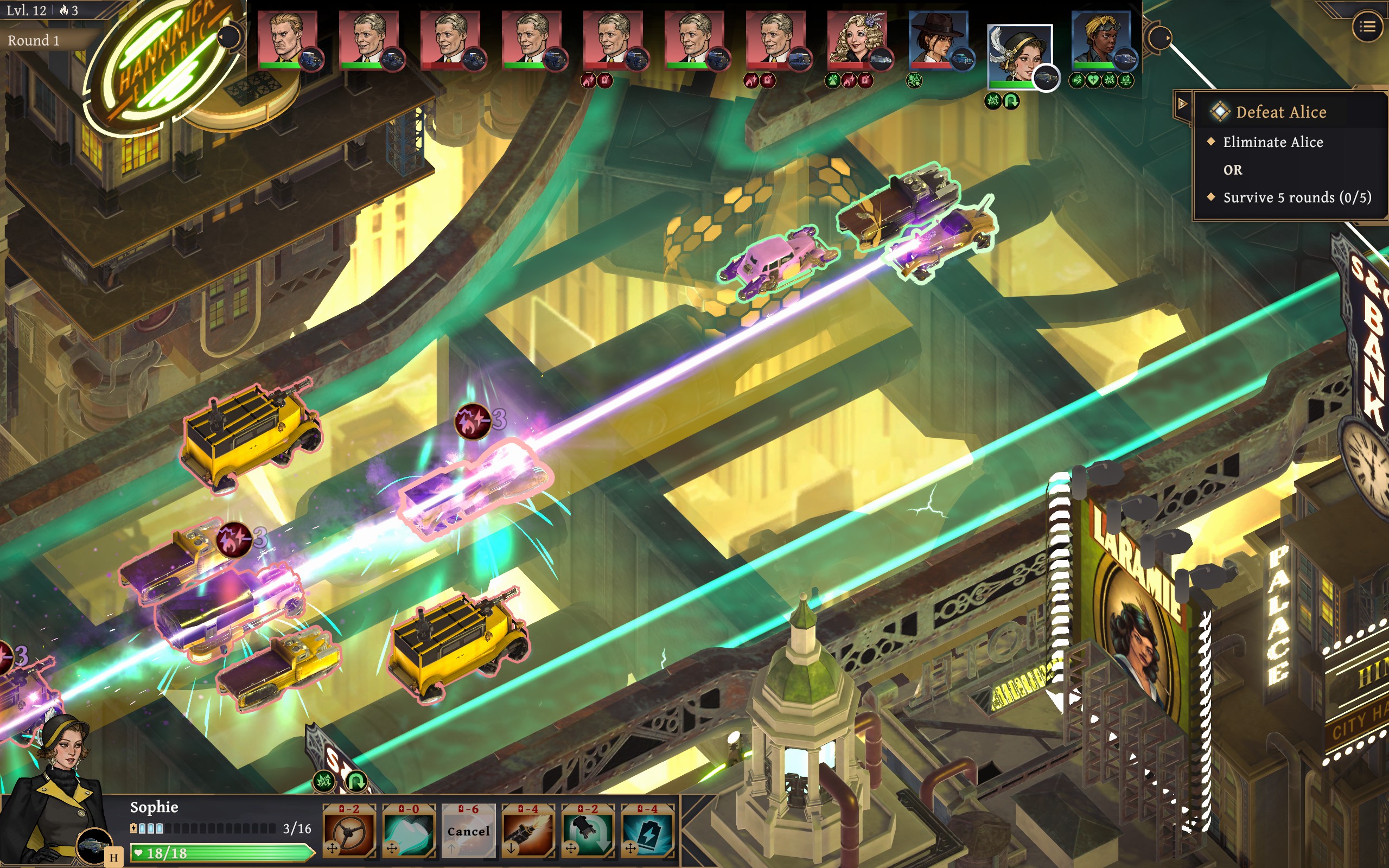
I open by firing the beam weapon mounted to the hood of my flying coupe, a Chevy-ass gangstermobile that zooms across the glowing streets of New York. Then I jump over my enemy so I can soften them up with the rear-mounted pistol, pull a bootlegger's turn, and hit 'em with the beam again.
That finishes them off, then sending them hurtling down the highway to collide with an innocent bystander's car. "Ah, my transmission!" he shouts, taking four points of damage as my turn comes to an end.
These parts of Aether & Iron are a turn-based Twisted Metal where it costs more action points to accelerate up the road than it does to weave through traffic as you drop back, and undercarriage mine launchers fill the streets with wreckage that those suckers at the back will have to dodge.
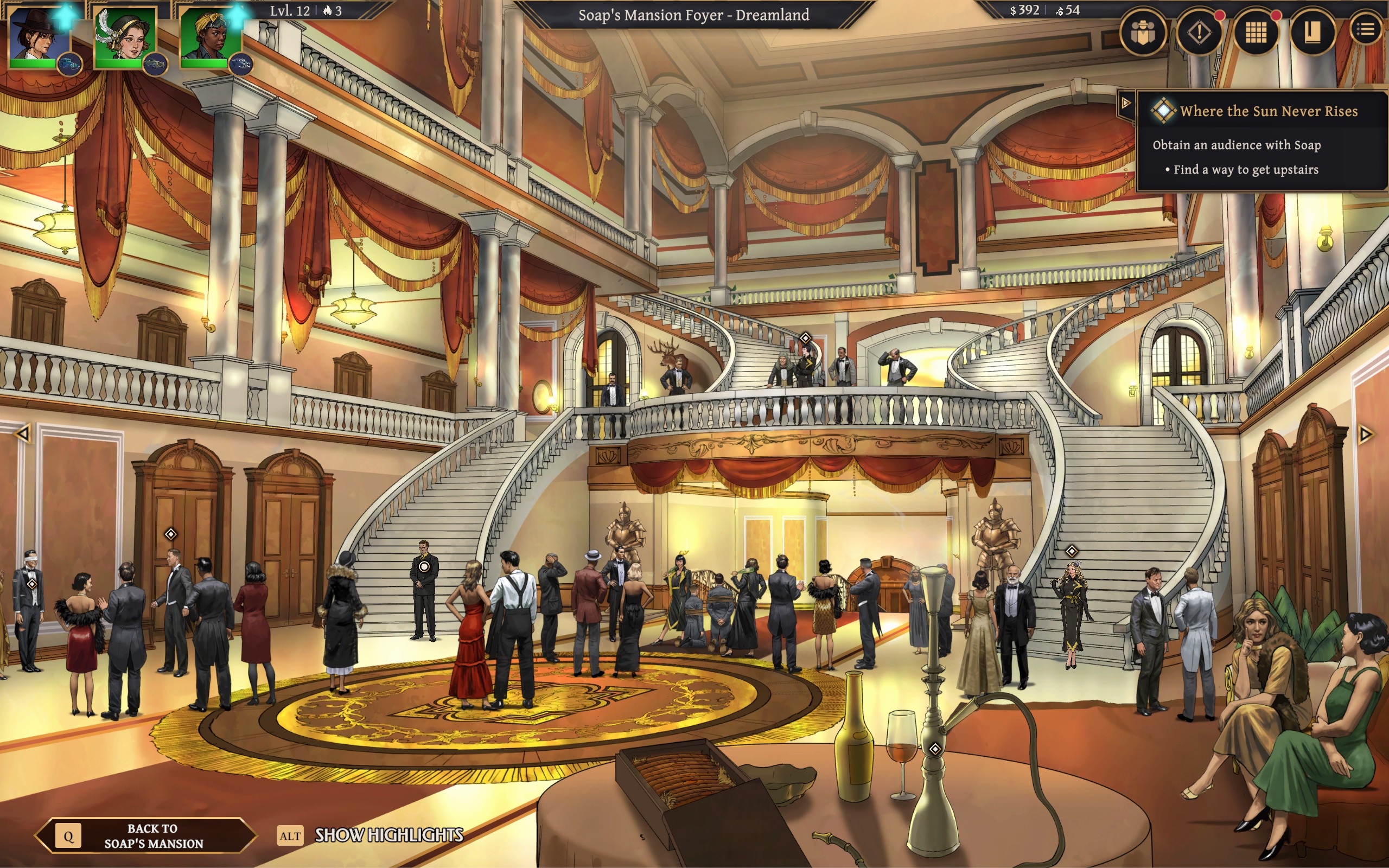
The other half of Aether & Iron is a hardboiled RPG in an alternate 1930s where aether technology sent New York aerial, turning it into a network of floating boroughs connected by ferries, each ruled by a tyrannical baron. It's inspired by the real New York, but don't expect to meet Robert Moses or the Pinkertons — most of the cast are broad archetypes drawn from the era. As a cynical smuggler with a fine line in noirish narration, you get drawn into a plot that begins with a plucky young scientist's discovery that will shake the city, and soon has you tangled up with the Underground plotting to overthrow the worst of the barons.
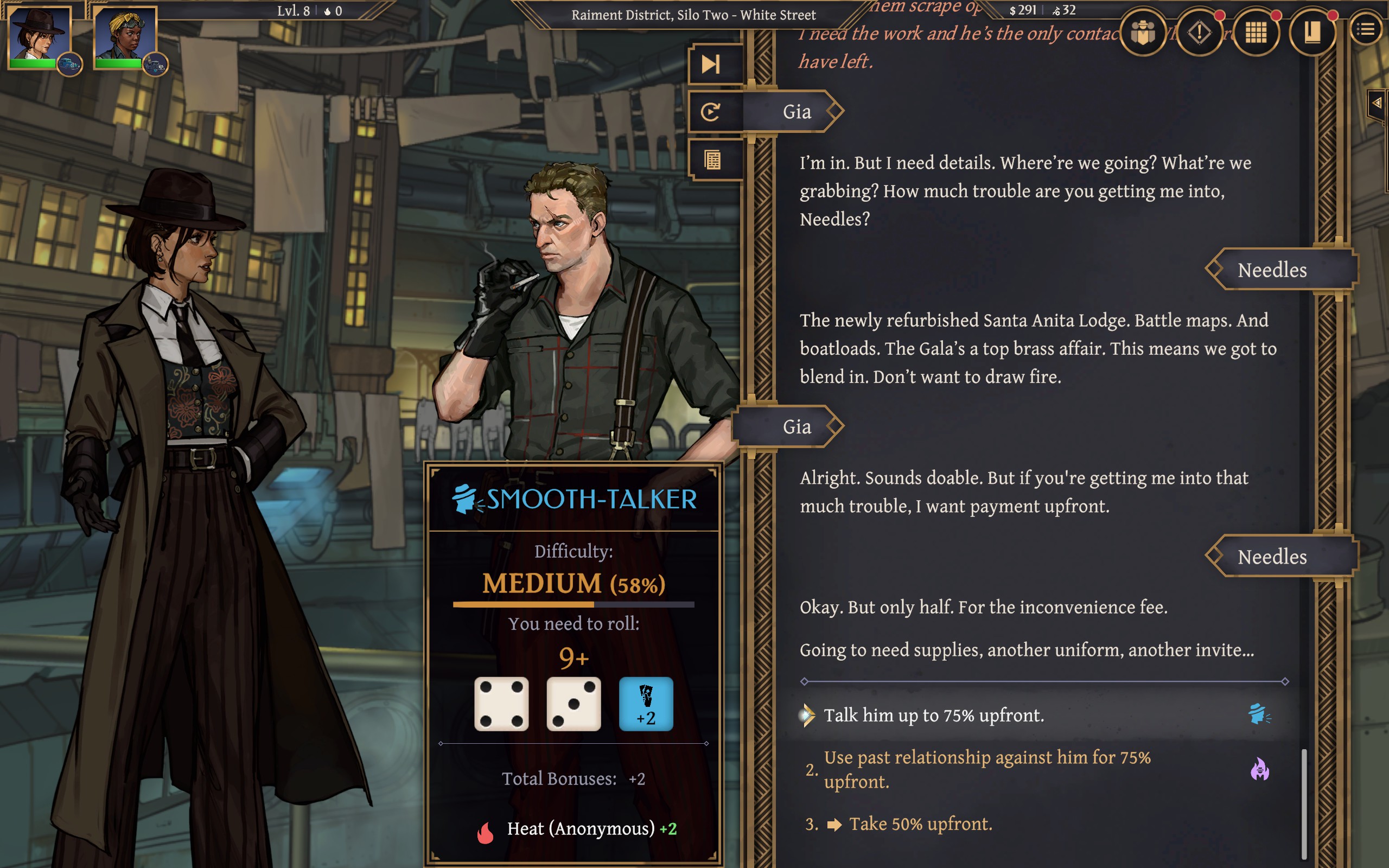
The story's told through fully voiced dialogue broken up by skill checks where you roll 2d6 and add your score in the relevant skill, like Gumshoe for figuring out clues or Grease Monkey for mechanical know-how. It's a bit Disco Elysium even down to your deaths being recounted as newspaper headlines, only without Disco's skill-based backchat or isometric walkabouts.
(Image credit: Seismic Squirrel)
All that professional voice acting and engaging tactical combat mustn't come cheap, which Aether & Iron makes up for with exploration sequences closer to a visual novel. Each location's a 2D landscape with points of interest to click on and NPCs to interact with, their portraits sliding in from the side of the screen and switching between a handful of broad emotional reactions to your choices. I don't miss all that isometric jogging from location to location you get in a typical CRPG, but your mileage may vary.
It feels lean and pacey. Without having to click, click, click your way across the screen, Aether & Iron gets to the good stuff fast. The only waiting is when you're on the overland map, hopping across islands to the next quest destination, or stopping off at a garage for repairs or a safe house to lower your Heat stat so it's easier to get through any checkpoints on your path.
Though broadly linear, a story of a predetermined character driving along a predetermined plot, there are a couple of sidequests and room to find alternate routes within the story. For instance, while infiltrating the grounds of a sinisterly fancy party I met some debauchees wearing animal masks while their companions without masks stood in cages. "Humans go in cages!" they chanted at me, so I grabbed a lion mask and did an unconvincing roar so I didn't have to join in whatever kink this was.
I could no doubt have engaged with them more to find a way inside the building, but instead I passed a skill check to play art critic to a barmy artist throwing paint at cattle on the lawn, took her paint, sneakily dumped it on the guard's car, and got inside while everyone was distracted.
(Image credit: Seismic Squirrel)
Inside the party, another gauntlet of wacky rich people waited. I had to pick one of their games to participate in to prove I was interesting enough to be allowed upstairs, during which I recognized a kid I'd met in a previous quest and recommended for a job. Now she was being forced to play judge over two gamblers accused of breaking absurd rules—facing a punishment of being drowned in wine, and not in a fun way—a situation I put her in by blithely trying to rescue her from her street urchin life. There's reactivity and consequence even within a storyline that's overall as linear as any of the highways combat takes place on.
The combat starts out so easy you barely need to think about it, but suddenly ramps up at the end of act one. I found myself needing to reload an earlier save where I had access to a shop and a garage so I could change my crew's vehicles around and tinker with their loadouts. You can't hotswap the weapons or utility tools on your vehicles on the fly, and can't even use the repair kits in your inventory mid-combat—though you can at least use a welding arm on the back of your truck in the middle of a shootout.
(Image credit: Seismic Squirrel)
I only hit a few walls like that during the 20-something hours it took to finish Aether & Iron, but it was always awkward to back up and go around. A game over after a skill check meant repeating an entire conversation to get back to that point and roll the dice on whether I'd have to reload again; a final boss fight with three phases and no opportunity to repair between them meant a long trip back to the garage to prepare for it. When Aether & Iron is in gear it fairly barrels along, so it's even more jarring when it stalls.
Mostly, though, it's a great example of the kind of RPG that feels like a home game complete with broad caricatures and absurd solutions (the cow paint!) and coming to it after Esoteric Ebb, a densely political RPG that boils down to "voting matters and democracy's good," it's nice to play a game that asks, have you considered Violent Revolution?
This week: Made progress in Warhammer 40,000: Boltgun, the best throwback FPS I've ever played.
When a casual FPS enjoyer expresses a preference for a particular feature of Call of Duty, they are unknowingly picking a side. The way soldiers run, how attachments work, the shape of the maps—seemingly minor details are live ammo in a 20 year war between factions of gaming's strangest fandom.
A normal long-running game series is likely to have a singular direction—a continuity or consensus that determines what present and future iterations will look like. When Assassin's Creed shifted from stealth action games to lite RPGs in 2017, that became the direction for all of Ubisoft's studios making Assassin's Creed games. Not Call of Duty: it has a coalition of 11 studios working around the clock to produce a $70 videogame every 12 months, and those studios are rarely on the same page. Activision's fiefdoms collaborate to varying degrees to get the job done, but its two lead studios have very different, often opposing ideas of how Call of Duty should look, play, and evolve.
As Call of Duty attempts to rebound from its weakest year in a decade, it's worth examining this unusual arrangement. Activision's stringent schedule and widening creative differences, now spanning two decades, have created a splintered series mirrored in its increasingly tribalistic players. It's the Call of Duty schism, and it's fascinating.
The divide
Generally speaking, there are two studios steering Call of Duty's creative direction: Infinity Ward, the OG creators of the series and Modern Warfare, and Treyarch, the creators of Black Ops. The pair have taken turns with their takes on the bestselling military shooter since 2006, when Treyarch was tapped to make Call of Duty 3 (as well as 2005's Big Red One) while Infinity Ward took extra time on the first Modern Warfare (2007).
While it's fair to say Treyarch was the "secondary" Call of Duty studio in those early days, Black Ops (2010) changed that. With its campy Cold War spy story, non-traditional guns, and party modes, Black Ops established Treyarch as the "fun" Call of Duty studio. Maybe it couldn't match Infinity Ward in terms of raw craft, but the first Black Ops was an even bigger sales hit than Modern Warfare, and distinguished itself by loosening restraints and not taking these silly blockbuster shooters so seriously.
Activision's full Call of Duty arsenal. (Image credit: Activision Blizzard)
I didn't know it at the time (being 14 and all), but this was the beginning of the schism. Black Ops is the first time I can remember heated arguments at school over whether this Call of Duty was better than the previous year's Modern Warfare 2—a talking point that defines Call of Duty discourse in 2026.
The specific design choices that folks argue over have changed alongside the FPS genre over the years, but the core of the studio debate remains remarkably consistent. There's nuance to these perspectives, of course, and there are some folks who don't really care either way, but there's a much louder contingent of fans who firmly believe one studio is killing Call of Duty and the other is its savior. Let's talk about the two camps.
(Image credit: Activision)
The Infinity Ward argument
Fans of Modern Warfare believe Infinity Ward's games:
Look better
Sound better
Move Call of Duty forward
Are more grounded and mature
Produce standout campaigns
Those who prefer Infinity Ward's take on Call of Duty are likely to cite a higher qualitative bar. The Modern Warfare series tends to be less flashy and adventurous than Treyarch's Black Ops, but what you get in return are the best-looking and -playing versions of Call of Duty. Infinity Ward excels at the "little" things—weapon sounds, reload animations, bullet feedback—that make Call of Duty a fundamentally satisfying shooter. The Modern Warfare "level up" stinger is the iconic example:
This sticking point goes all the way back to the early 2010s, when a new Black Ops would arrive looking less impressive than the Modern Warfare that came before it, with the exception of Treyarch's superior fire tech. While Treyarch has narrowed the gap on sound and animations over the years (especially after it switched to Infinity Ward's engine in 2024) the difference is still plain enough to see that most Treyarch fans won't argue this point.
Modern Warfare enjoyers may also prefer the way Infinity Ward does a campaign, a style marked by international task forces, NATO alphabet barks, and Captain Price's dependable mustache. These, too, aren't as ostentatious as a Black Ops romp where characters hallucinate a zombie horde or infiltrate a Clinton rally, but deliver more grounded, often jingohistic fantasies—stealthy sniper missions, AC-130 bombardments, night vision raids in foreign countries, etc.
There's also no denying that Infinity Ward still sets the tone for Call of Duty's future. The first Modern Warfare established the series' blueprint in 2007, and even at the peak of Black Ops, you could argue Treyarch's games are largely variations on Infinity Ward's designs. When Call of Duty's relevance waned between 2016 and 2018, it was the technical advancements and excellent gunplay of the Modern Warfare reboot that reinvigorated the series.
Does Infinity Ward only achieve these leaps because Activision gives it a longer leash and more time?A fair question, but it nevertheless contributes to the perception that a new Infinity Ward game is a special occasion.
The Treyarch argument
Fans of Black Ops enjoy that Treyarch's games have:
Faster movement
Longer time-to-kill
3-lane multiplayer maps
Better campaigns
Zombies
The Treyarch crowd undeniably skews hardcore. Many are especially active Call of Duty players, streamers, or content creators who take the competition seriously and are hungry for evolution specific to their interests. Treyarch has recognized these interests throughout the Black Ops series, designing and marketing its games around gameplay adjustments for high-skill players: fast movement, expressive sliding techniques, double jumping, jetpacks, and most recently non-skill-based matchmaking.
A Black Ops enjoyer might believe the Modern Warfare games are too slow, low skill, or less balanced while championing the strides Treyarch makes toward consistent and competitive Call of Duty multiplayer: less visual recoil, standardized 3-lane maps, and detailed weapon stats.
(Image credit: Activision Blizzard)
The Treyarch crowd undeniably skews hardcore.
In recent years Treyarch has also distinguished itself by taking Infinity Ward's Gunsmith customization system and expanding on it with "prestige attachments" that dramatically change a gun's behavior. Revolvers can become sniper rifles. ARs can have underbarrel flamethrowers. There are few rules.
The casual Treyarch diehard also appreciates the Black Ops series' playful playlists—Modern Warfare will sometimes indulge in offbeat modes, but it's got nothing on Black Ops mainstays like Prop Hunt, One in the Chamber, Sticks and Stones, and Gun Game. Then there's Zombies: the beloved co-op mode of Treyarch's creation that's ballooned in scope over time to have its own lore and dedicated fans, all of which has no equal in Modern Warfare.
It doesn't go unnoticed by Treyarch fans that when the Black Ops series makes universally popular changes, Infinity Ward might ignore or drop them in its next game. This contributes to the perception that Treyarch makes games "for the fans" while Infinity Ward only listens to itself.
(Image credit: Activision Blizzard)
What about Sledgehammer and Raven?
Sledgehammer Games also makes its own Call of Duty games. Or at least, it used to: For a time, it was the "third" Call of Duty studio slotted into the rotation to accommodate ballooning development times across the industry. Its first standalone project, 2014's Advanced Warfare, was popular, but its two World War 2-themed followups were not. Since Call of Duty: Vanguard, Sledgehammer has seemingly been demoted to support studio, assisting on and co-developing yearly releases.
Recently, Sledgehammer stepped in to co-develop Modern Warfare 3 (2023), a rushed sequel to Modern Warfare 2 (2022) that Infinity Ward wasn't involved with. It reviewed poorly and didn't sell much better, but it was popular with hardcore players for the ways it backtracked on Infinity Ward's decision to slow Call of Duty back down a year prior.
Raven Software is the other major series contributor. The storied FPS developer behind classics like Hexen and Star Wars: Jedi Knight was conscripted to full-time Call of Duty work in the 2010s, serving as co-developers on all of Treyarch's recent Black Ops games and battle royale spinoff Warzone. The studio has never gotten the chance to lead a project, but the influence of Warzone and its integration into "premium" Call of Duty has catapulted into a free-to-play juggernaut.
(Image credit: Activision Blizzard)
The studio imbalance
Sledgehammer's fate is emblematic of an imbalance within Activision's Call of Duty factory. What used to be a predictable two-to-three year cycle with clean handoffs between studios has become a mad dash to make whatever is possible by a deadline—a workload that has disproportionately fallen to Treyarch, Raven, and Sledgehammer in the 2020s.
Look at the last six years of Call of Duty and you'll see what I mean:
Modern Warfare 2: Infinity Ward (lead), Sledgehammer/Raven (assisting)
Modern Warfare 3: Sledgehammer (lead), Raven/Treyarch/Infinity Ward (assisting)
Black Ops 6: Treyarch (lead), Raven (Campaign), Sledgehammer (assisting)
Black Ops 7: Treyarch and Raven (co-lead), Sledgehammer/Infinity Ward (assisting)
So far this decade, Infinity Ward has made exactly one Modern Warfare sequel while Treyarch, Raven, and Sledgehammer have upped their pace. This is not how it used to work and, I imagine, not ideal to the frontline developers.
When I zoom out, I see that Call of Duty has actually been on two cycles all along: once a year there's a new Call of Duty, and once a decade there's a point where that unrealistic pace catches up to Activision, and the series adopts a posture of desperation—new features are less new, old maps are added to new games to pad out a many-boxed roadmap, and player sentiment tanks. We've been at that point since Modern Warfare 3.
(Image credit: Activision)
Modern Warfare loyalists can't wait for Infinity Ward to be back in control, while the loudest Treyarch fans believe Call of Duty has been better off without them.
From the outside, it's an arrangement that seemingly casts Infinity Ward as the flagship studio afforded as many years as it needs to make the next evolutionary Modern Warfare, while Treyarch, Sledgehammer, and Raven are tasked with keeping the lights on with quickly-made sequels that suffer diminishing returns.
This setup may work for Activision, which gets to sell boatloads of $70 boxes every Fall without fail, but it further fuels the schism. Nobody can agree on what "peak" Call of Duty is, and what used to be fun changings of the guard are now treated like existential threats—Modern Warfare loyalists can't wait for Infinity Ward to be back in control, while the loudest Treyarch fans believe Call of Duty has been better off without them.
That makes 2026 a big year for all involved. Four years since Modern Warfare 2, it's finally Infinity Ward's turn again. This year's Call of Duty will presumably have had the longest development period in series history, and it's coming on the heels of a Black Ops sequel that not even the Treyarch crowd is playing. That sets expectations sky high: Will Infinity Ward revive Call of Duty once more, or prove that Treyarch has become its new masters?

 Login
Login